Screen printing – how it works?
Probably everyone who is interested in printing on t-shirts asks:
– what is the difference between silkscreen printing and thermal printing?
In this article we will try to tell You what actually happens the image on the fabric by screen printing and its fundamental differences from thermal printing.
This method of application is rooted in antiquity: the first traces of such a drawing technique found in Ancient Egypt it was used to decorate tombs.
Further – China(III century BC/.e – VI century ad/CE), where this method is turned into art and began to acquire features of modern screen printing.
Drawing of the image from the silkscreen, thermal printing is fundamentally different – the paint lays down on the fabric in liquid form, penetrates the structure of the tissue enveloping the fibers is thereby significantly increased the use of such things. In the thermal transfer film has an adhesive layer, which secures the monochrome image on the fabric by exposure to high temperatures. Image in thermal printing does not have gradients and CMYK printing in this kind of application impossible.
For screen printing there is no limitation in the type of fabrics and the image quality – with the right use of varieties of colors, it is possible to print image even on fabrics with polyamide and polyester fibers(which are characterized by a hydrophobic).Image possible both solid and gradient. Paint organoleptic properties as different. Depending on the type and additive image can not be felt to the touch and can be embossed.
Let us gradually consider all stages of screen printing with one colour on the t-shirt example:
1. Fabric preparation for coating.
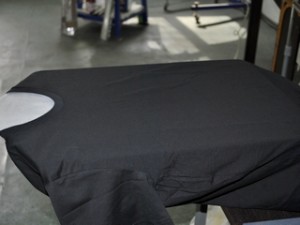
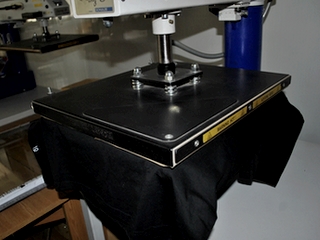
t-Shirt is placed on a horizontal surface of the printing press. T-shirt stack on the table pre-coated with an adhesive (lock), to prevent displacement of the product during the printing process. It is important that the product was clean and had no creases.
2. Drawing of the image.
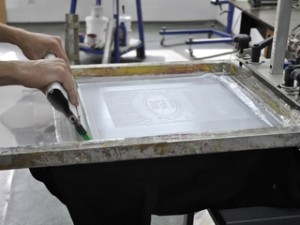
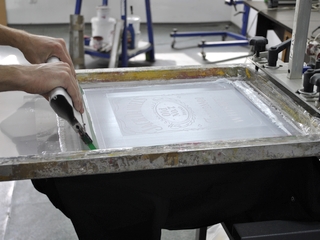
On the prepared surface drops prepared with the stencil frame. Then recalim the ink is forced through the holes in the stencil evenly distributed over a given area.
If you require more saturation of color, the procedure was repeated, pre-drying the previous layer flash drying.
3. The drying layer of paint.
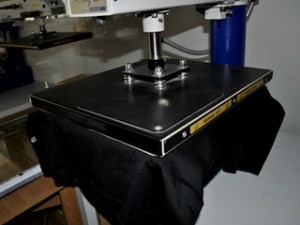
After applying another layer of paint must be dried at temperatures that are recommended by the paint manufacturer.